
Introduction to
Epilepsy
Epilepsy is a neurological disorder marked by sudden recurrent episodes of sensory disturbance, loss of consciousness, or convulsions, associated with abnormal
electrical activity in the brain.
0
%
feel a lack of information and resources are barriers to accessing support or treatment
they need

0
%
of people with epilepsy experience stigma, ranging from subtle biases to significant misunderstanding.

0
in 3
Nearly 2 in 3 people emphasise the urgent need for more community support and understanding to improve their quality of life

The Brain
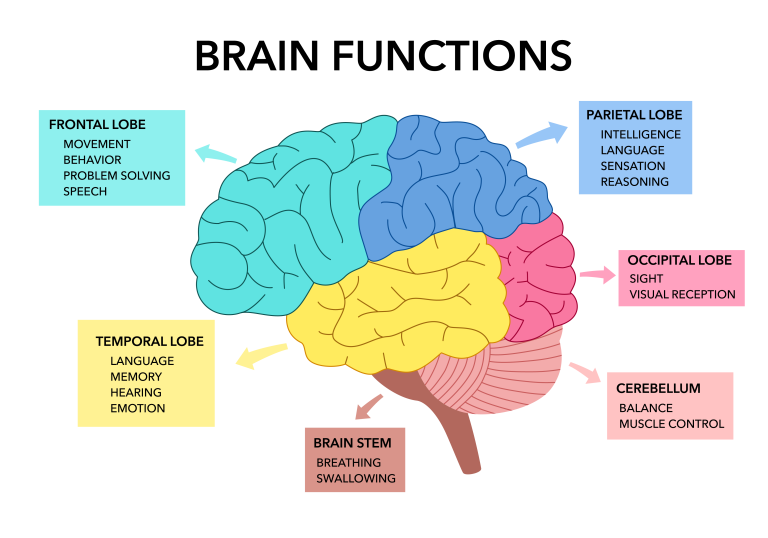
The brain is divided into different areas (lobes) and each lobe is responsible for different activities or functions.
Cerebrum or cerebral cortex
This is the largest part of the brain and is divided into the right and left hemispheres.
The left hemisphere controls the right side of the body and is usually responsible for
speech and language functions. The right hemisphere controls the left side of the body
and is usually responsible for processing visual and spatial information, and other
non-verbal skills.
The two hemispheres are linked by bundles of nerve fibres which allow communication
between each side of the brain.
Each hemisphere of the cerebrum is divided into the following lobes, which each have
different functions:
Frontal lobes
These lobes are responsible for:
- Executive function – decisions, planning ahead, attention, behaviour, emotion
- Speech and languageMemoryPlanned movement
Functions
- Organising thoughts on paper.
- Remembers facts.Starts and completes tasks.Tell stories.
Parietal lobes
These are the processing centres of the brain and responsible for:
- Perception, making sense of thingsSensation – touch, pain, hot or cold
Functions
- Taste.Touch.Smell.
- Temperature.
Occipital lobes
These process visual information and control the ability to recognise shape, colour, objects and faces.
- Visual SystemVisual information
Functions
- Processes words on a page
- Knows shapes and sizes. Recognises letters. Knows left from right
Temporal lobes
These are responsible for processing sound and understanding speech. They also form part of the system that controls memory. The left lobe processes receptive language and the right lobe processes musical awareness.
- Auditory processing.
- Short-term memory.
- Long-term memory.
Functions
- Processes.Fear.Fight or Flight
- Retains facts.
Cerebellum
This area of the brain is responsible for:
- BalanceCo-ordinationAttention.
- Rhythm.Proprioception.Vestibular.
Functions
- Kick and throw a ball.Jump on one foot.Rides a bike.
- Rhythm.Proprioception.Vestibular.
Brain stem
This area is responsible for the involuntary functions that keep us alive:
- Heart rateBreathingBlood pressure
Function
- Reflexes e.g. swallowing
- Breathing
- Eye movements
- Facial movements and sensations.