
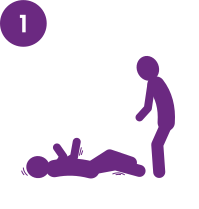
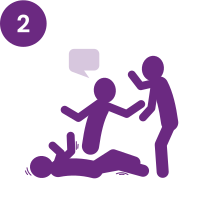
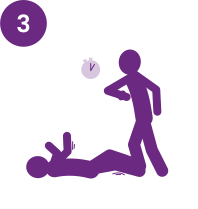
Seizures caused by abnormal brain activity can be divided into two groups, focal seizures and generalised seizures.
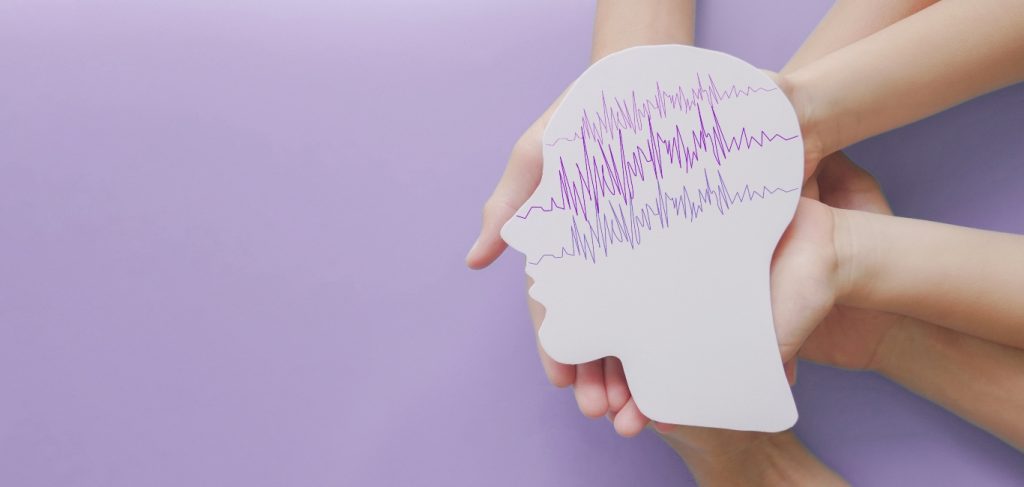

of people with epilepsy experience stigma, ranging from subtle biases to significant misunderstanding.


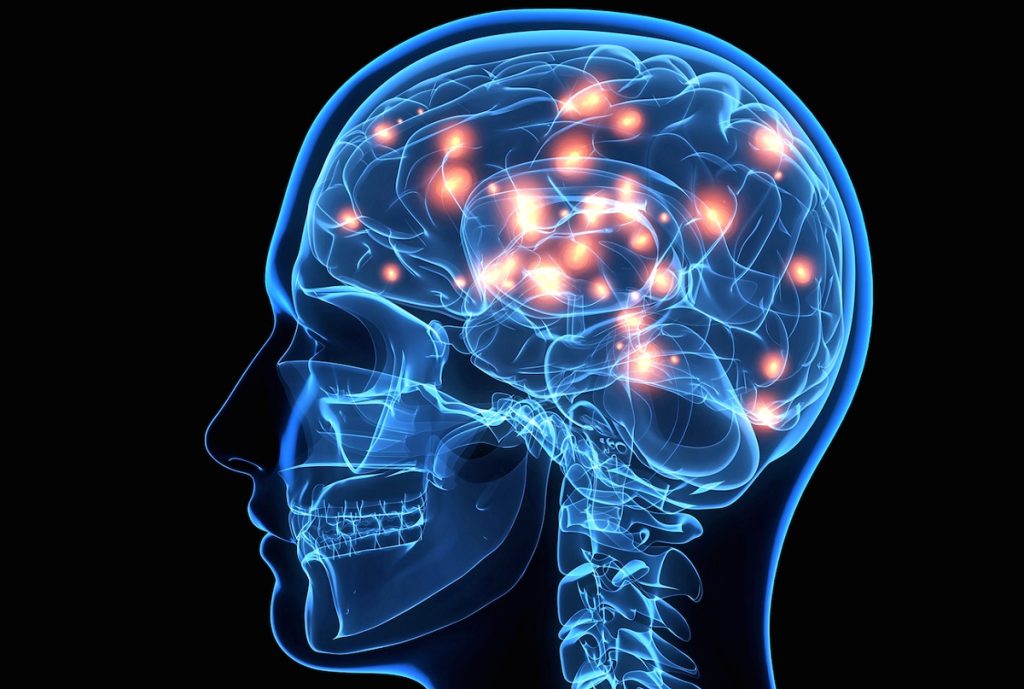
Seizures occur due to abnormal brain activity and are grouped into focal and generalised types.
Focal seizures affect one area of the brain, while generalised seizures involve the whole brain.
Each type causes different symptoms, from changes in awareness to muscle stiffness or jerking movements.
There at least 49 known types of epileptic seizures
Absence epilepsy seizures account for 2-4 percent of epilepsy. They are characterized by brief episodes of staring, usually lasting only 2-10 seconds and may happen repeatedly during the day. There is no warning before a seizure and the person is completely alert afterwards, with no memory of it. Because they are so mild, you might not even realize you had one and it’s easily not noticed by those around you.
May produce weakness or inability to use certain muscles, including those that govern speech. Frontal lobe seizures may involve thrashing movements during sleep, also stiffening with the head turned to one side and the arm rising into a brief frozen state. Some seizures may be dramatic and upsetting to others, with screaming, bicycling movements of the legs, running. Treatment is with medication, and, in some cases, surgery.
A kind of simple partial seizure. “Simple” in this context means patients do not lose awareness.
Partial means that abnormal neuron firing only occurs in part of the brain, and, accordingly, abnormal movement or sensation is limited to only part of the body.
The characteristic features of Jacksonian march are that it only occurs on one side of the body and it progresses in a predictable pattern from twitching or a tingling sensation or weakness in a finger, a big toe or the corner of the mouth, then marches over a few seconds to the entire hand, foot or facial muscles.Jacksonian march seizures are generally brief and relatively mild. They are episodic, come and go. There is no confusion afterwards. Sometimes patients may not even notice them.
Typically begins at puberty in otherwise healthy children. The first symptom is usually a generalized convulsion. These children may also have myoclonic seizures (jerking of the muscles) on awakening.
A hand may suddenly fling out, a shoulder may shrug, a foot may kick, or the entire body may jerk. A child may spill or drop whatever he or she is holding or fall from their chair. Absence seizures may also occur.
Juvenile myoclonic seizures can occur as a single event or in a series.
Lennox-Gastaut syndrome (LGS) is a rare and severe kind of epilepsy that starts in childhood.
Children with LGS have seizures often, and they have several different kinds of seizures.
The seizures usually start between ages 2 and 6. Children with LGS have learning difficulties and developmental delays (like sitting, crawling, walking) that can be moderate to severe.
They can also have behavioural problems. Each child develops differently, and it’s impossible to predict how a child with LGS will do.
While most children have ongoing seizures and some form oflearning disability, some may respond well to treatment and have fewer seizures. Others may continue to have seizures often, as well as problems with thinking, development, and behaviour, and will need help with daily living activities. Some parents find that a special diet, called theketogenic diet, helps
They are a form of simple partial seizures, which include clonic, jerking, convulsive movements. Jerking typically begins in one area of the body –your face, arm, leg, or trunk —and may spread to other parts of the body.
These seizures are sometimes called Jacksonian motor seizures, their spread is called a Jacksonian march andthey cannot be stopped.
Neonatal seizures occur in babies soon after birth. As many as 1.5 to 2.5% of newborns have seizures in the first month of life.
A further 20% of all seizures in children under 3 years of age have neonatal seizures. They’re generally classified as subtle, clonic, tonic, and myoclonic.
Subtle attacks are characterised by apnoeas with episodes of pallor, fixed staring, deviation of one or both eyes, eye blink, motor changes, episodic chewing movements, or stereotypic limb movements such as swimming or bicycling motions. Drooling and unusual alertness may accompany neonatal seizures.
Usually, most neonatal seizures occur over only a few days and fewer than half of affected infants develop seizures later in life.
These are usually tonic-clonic. They might occur just after a person has fallen asleep, just before waking, during daytime sleep, or while in a state of drowsiness.
People who experience nocturnal seizures may find it difficult to wake up or to stay awake.
Although unaware of having had a seizure while asleep, they may arise with a headache; have temper tantrums, or other destructive behaviour throughout the day
Partial (focal) seizures occur when this electrical activity remains in a limited area of the brain. The seizures can sometimes turn into generalized seizures, which affect the whole brain. This is called secondary generalization.
Partial seizures can be divided into:
Certain types of flickering or flashing light may incite a seizure. The trigger could be exposure to television screens due to the flicker or rolling images, computer monitors, certain video games or TV broadcasts containing rapid flashes, even alternating patterns of different colours, in addition to intense strobe lights. Can also be triggered by natural light, such as sunlight, especially when shimmering off water, even sun flickering through trees or through the slats of Venetian blinds.
This is a reflex epilepsy where seizures are triggered by reading. Usually begin in adolescence, & onset is unusual in younger children or adults over 30 years old. Person may have jaw jerking or clicking while reading, often with jerks of the arms, & if reading continues, a generalized convulsion may occur. Transient cognitive impairment has also been noted with the jerks.
Also known as pseudo seizures, they are not due to epilepsy. Psychogenic seizures can occur at any age, but are more common in people under the age of 55.
They occur three times more frequently in women than men.
They may arise from various psychological factors, may be prompted by stress, and may occur in response to suggestion.
Some individuals with psychogenic non-epileptic seizures may have previously experienced trauma, such assexual abuse.
Also called Chronic Focal Encephalitis (CFE). This is a rare, progressive neurological disorder, which affects one half of the brain, producing severe seizures, loss of motor control and speech along with paralysis on one side of the body, inflammation ofthe brain and dementia.
These seizures begin in one part of the brain, either as a simple partial seizure (last less than one minute and the person may show different symptoms depending upon which area of the brain is involved) or complex partial (commonly occur in the temporal lobe of the brain), and then spread to involve both sides of the brain where consciousness is lost.
Clinically, it looks exactly like a generalized tonic clonic seizure (when a burst of electrical energy sweeps through the whole brain at once, causing a loss of consciousness, falls, and convulsions).
Some simple partial seizures consist of a sensory experience. People with sensor seizures may smell or taste things that aren’t there, hear clicking, ringing, or aperson’s voice when there is no actual sound. You may also see lights, hear a buzzing sound, or feel tingling or numbness in a part of the body.
Simple partial seizures usually last just a few seconds, although they may be longer. If there are no convulsions, they may not be obvious to those around you.
Apartial (focal) seizure happens when unusual electrical activity affects a small area of the brain.
When the seizure does not affect awareness, it is known as a simple partial seizure. Simple partial seizures can be affecting the muscles of the body, affecting the senses, affecting automatically controlled functions and affecting feelings or thoughts. Simple focal seizures are also known as auras.
Symptoms of simple partial seizures are: Muscle tightening, Unusual head movements, Blank stares, Eyes moving from side to side, Numbness, Tingling, Skin crawling (like ants crawling on the skin), Hallucinations-seeing, smelling, or hearing things that are not there, Pain or discomfort and Nausea.
This is a type of reflex epilepsy in which seizures are provoked by loud noises or sudden surprises.
Most patients with startle epilepsy are only sensitive to one sensory modality (i.e. temperature, taste, sound, pressure); however, it is the unexpected nature of the stimulus, rather than the sensory modality, that characterizes startle epilepsy.
These seizures usually last less than 30 seconds. The seizure begins with a startle response, followed by a brief tonic phase.
Patients sometimes fall to the ground and experience clonic jerks. Responsiveness to the stimulus decreases as a result of repeated exposure to the stimulus. Spontaneous seizures also occur in patients with startle epilepsy, but are infrequent in most cases.
People with startle epilepsy usually have static cerebral lesions and developmental delay. For many people, half of the body is partially paralysed and it is the weak side of the body that is primarily involved in thestartle seizures.
Startle epilepsy is often associated with disorders such as Down syndrome and cortical dysplastic lesions.
Status epilepticus is defined as:
Generally speaking, the risk of post traumatic seizures is related to the severity of the injury. The greater the injury, the higher the risk of developing seizures. Even mild to moderate injuries can result in seizures.
A type of epilepsy causing focal seizures beginning in the temporal lobe area of the brain.
One or both lobes may be affected. There may be
18an aura warning sign before aseizure, but not everyone will experience this.
Temporal lobe epilepsy may cause either simple partial seizures without loss of awareness or complex partial seizures with a loss of awareness.
Tonic seizures are characterised by facial and muscle spasms of your trunk, flexing or reaching of your upper and lower extremities, and impaired consciousness. Several types of tonic seizures exist. The more prolonged seizures usually are convulsive and may manifest dilation of your pupils, tachycardia, apnoea, a bluish tinge to your skin, salivation, and the loss of bladder or bowel control. Tonic seizures are often followed by postictal confusion.
You will probably give out a short cry and fall to the floor. Your muscles will stiffen during the tonic phase and then, during the clonic phase your extremities will jerk and twitch. Often you will lose consciousness, stop breathing or have difficulty breathing, turn blue and lose bladder control which in not uncommon, but extremely embarrassing.
Afterwards, you may feel tired, confused and disorientated. This may last from 5 minutes to several hours or even days. Rarely, this disorientation may last up to 2 weeks. You may asleep, or gradually become less confused until full consciousness is regained
While epilepsy is commonly accompanied by dizziness or vertigo, vertigo is only rarely caused by epilepsy. This arises primarily because vertigo is much more commonly caused by ear conditions.
Epileptic vertigoisdue to brain injury, typically the part of the temporal lobe that processes vestibular signals. Loss of consciousness usually occurs at the time of injury. The typical symptom is “quick spins”.
This type of seizure is seen when certain medications, such as barbiturates and benzodiazepines, are stopped abruptly.
In this case, continued treatment with antiepileptic medications is usually not advisable. Withdrawal seizures are common when a person with alcoholism is trying to quit drinking.
If a person with epilepsy drinks alcohol heavily and experiences withdrawal seizures, it is difficult for the physician or specialist to determine the exact cause of the seizure and to determine the next appropriate step. Therefore, it is important to avoid alcoholic beverages once you begin taking antiepileptic medications.